
Running a business today means being available to customers almost all the time. People want quick answers, easy access to information, and support whenever they need it. Whether someone is browsing your website, comparing products, or trying to resolve an issue, they don’t necessarily want to wait hours for a response.
This is where AI chatbots can make a real difference.
An AI chatbot is no longer just a small chat window that gives visitors a few pre-written answers. Modern AI-powered chatbots can understand questions, respond naturally, recommend products, collect customer information, qualify leads, and even help businesses automate parts of their sales and customer support processes.
For small businesses, startups, and growing companies, this technology offers an opportunity to provide better customer experiences without constantly increasing operational costs.
But are AI chatbots actually worth implementing?
Let’s look at 10 practical benefits of using an AI chatbot for business and how they can help you save time, improve customer relationships, and grow your revenue.
What Is an AI Chatbot for Business?
An AI chatbot for business is a software application that uses artificial intelligence to communicate with customers through a conversational interface.
It can be integrated into a business website and, depending on the platform, connected to messaging channels such as WhatsApp and other communication tools.
Unlike traditional chatbots that rely entirely on predefined questions and answers, modern AI chatbots can understand the meaning behind customer questions and generate relevant responses using the information and instructions provided to them.
For example, imagine someone visiting an online store and asking:
“I’m looking for a lightweight moisturizer suitable for dry skin. Which product would you recommend?”
A basic chatbot might simply display a list of product categories.
An AI chatbot can understand the question, refer to the store’s product information, and recommend a suitable product with an explanation.
That difference can have a significant impact on the customer experience.
10 Benefits of Using an AI Chatbot for Business
1. Provide 24/7 Customer Support
One of the biggest advantages of an AI chatbot is that your business doesn’t have to stop responding to customers when your office closes.
Think about how many potential customers browse websites outside normal business hours. Someone might visit your website at 11 PM, have a question about your services, and leave because nobody is available to answer.
You could lose that opportunity without even knowing it.
An AI chatbot can respond to customer questions around the clock, including weekends and holidays.
It can help visitors with:
- Product and service information.
- Pricing and package details.
- Business hours and contact information.
- Shipping and delivery questions.
- Frequently asked questions.
- Basic troubleshooting and support.
Your customers get immediate assistance, while your team can focus on tasks that genuinely require human attention.
Real-world example: A customer visits a web design agency’s website late at night. They ask about website development packages, turnaround times, and available services. The chatbot provides relevant information and collects their contact details so the agency can follow up the next morning.
The conversation happens even when nobody is sitting in the office.
2. Reduce Customer Support Costs
Hiring and maintaining a customer support team can be expensive, especially for small businesses.
There are salaries, training expenses, employee management, and the time required to handle repetitive questions every day.
Many customer inquiries are actually quite predictable.
Customers repeatedly ask questions such as:
- Where is my order?
- What are your business hours?
- How much does this service cost?
- Do you offer refunds?
- How can I contact your team?
- What is included in this package?
An AI chatbot can handle many of these common inquiries automatically.
Instead of having employees answer the same questions throughout the day, your team can concentrate on complicated customer requests, sales conversations, and business operations.
| Traditional support | AI chatbot support |
|---|---|
| Requires staff availability | Available around the clock |
| Repeated manual responses | Automates common questions |
| Limited simultaneous conversations | Can handle multiple conversations |
| Additional staffing as demand grows | Can scale without hiring for every increase in inquiries |
| Employee time spent on repetitive tasks | More time for complex issues |
An AI chatbot doesn’t necessarily eliminate the need for customer support employees. Instead, it helps businesses use their team’s time more effectively.
3. Generate More Leads From Your Website
Getting visitors to your website is only half the battle. Turning those visitors into potential customers is what actually matters.
Unfortunately, many people visit business websites, browse a few pages, and leave without contacting anyone.
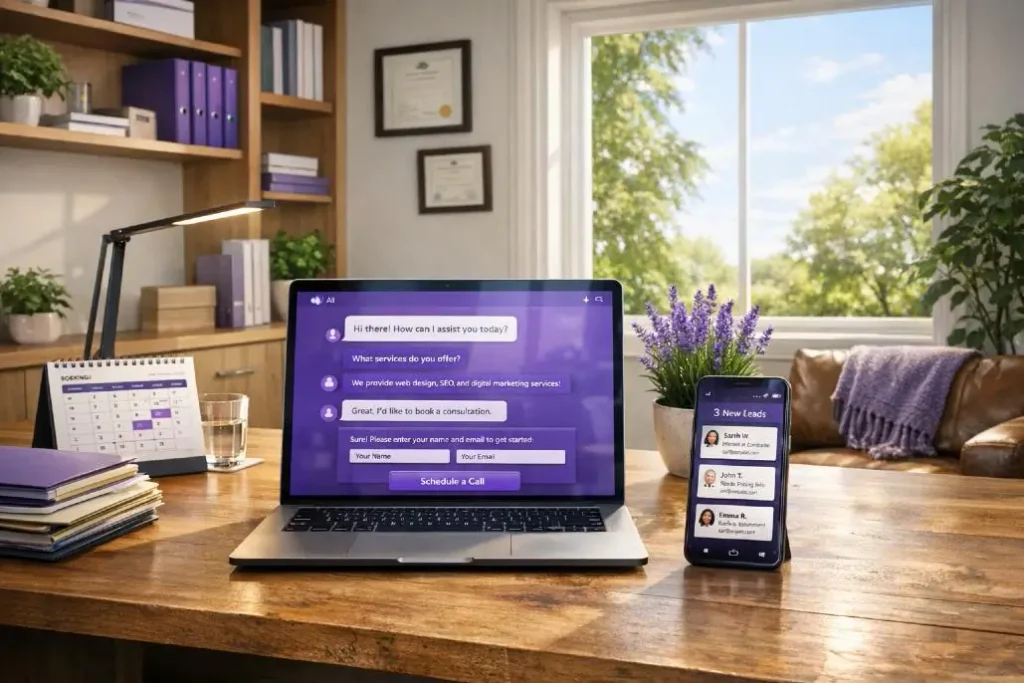
An AI chatbot gives visitors an easy way to start a conversation.
Rather than searching for a contact page or filling out a lengthy form, they can simply ask a question.
The chatbot can then collect useful information, such as:
- Name and email address.
- Phone number, when appropriate.
- Products or services they’re interested in.
- Their budget or requirements.
- Their preferred time for a consultation.
It can also ask follow-up questions to understand whether someone is genuinely interested in your offering.
For example, a real estate agency could use an AI chatbot to ask visitors about their preferred location, property type, budget, and buying timeline.
The business receives more organized inquiries instead of random website messages.
Why this matters: Your website becomes more than an online brochure. It becomes an active channel for generating and qualifying business leads.
4. Improve Customer Experience With Instant Responses
Customers don’t like waiting, particularly when they have a simple question.
Imagine visiting an online store, finding a product you like, and wanting to know whether it is available in your size. If you have to wait until the next business day for an answer, you might simply purchase from another website.
Instant responses remove this unnecessary friction.
An AI chatbot can provide immediate answers to common questions, guide visitors through your website, and help them find the information they need.
It can also maintain a natural conversation instead of forcing visitors to navigate through multiple menus.
For businesses, this creates a smoother customer journey.
The easier it is for customers to get information, the fewer obstacles they face when making a purchasing decision.
5. Increase Sales and Conversion Rates
An AI chatbot can do more than answer questions. It can actively assist customers during the buying process.
Think of it as having a virtual sales assistant available on your website.
For example, an online clothing store could use an AI chatbot to help customers choose products based on their preferences.
A visitor might ask:
“I’m looking for a casual outfit for a summer vacation. What would you recommend?”
The chatbot can suggest relevant products, explain their features, and guide the customer toward the product pages.
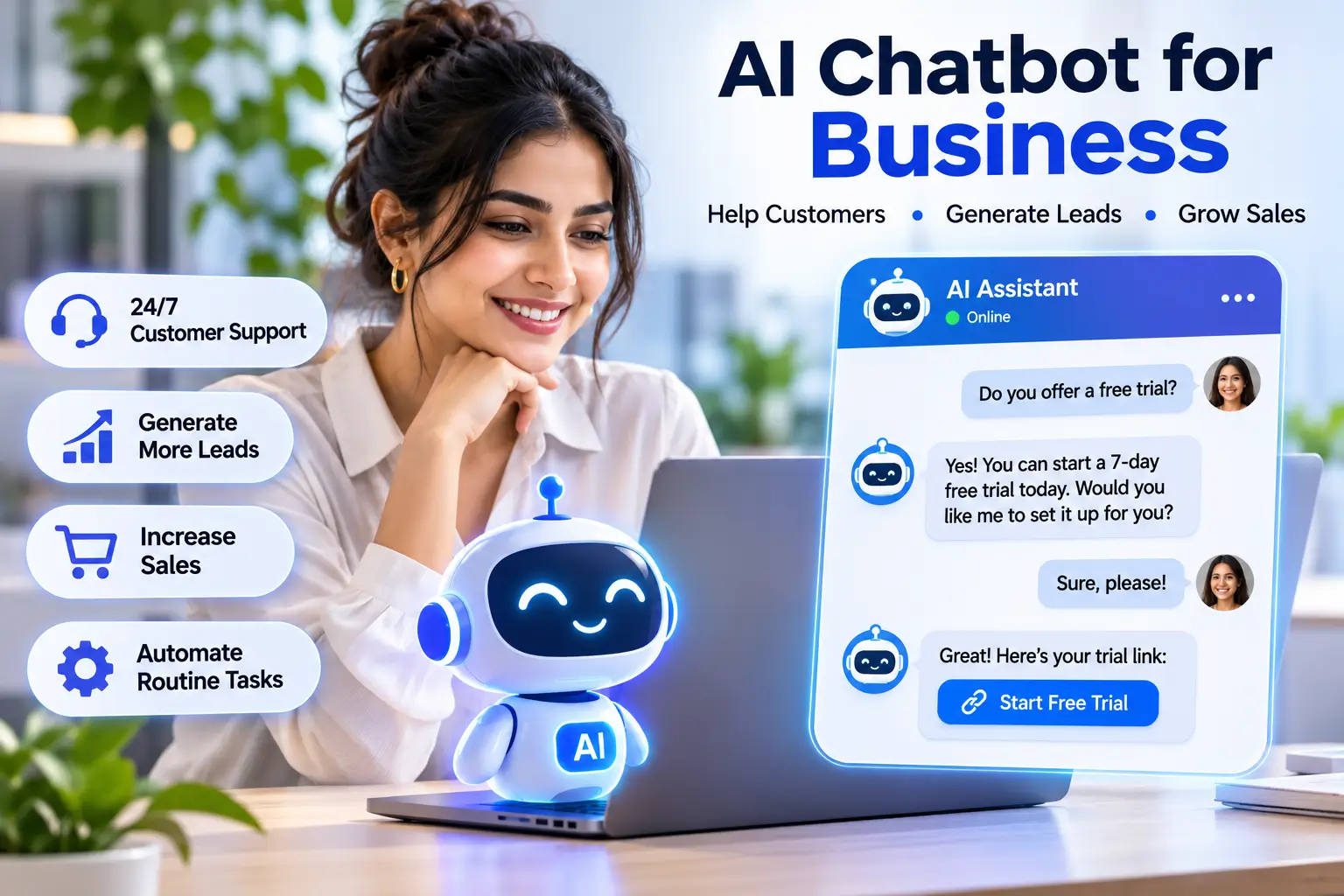
Similarly, a software company could use a chatbot to explain subscription plans, compare features, and direct interested visitors toward a free trial or consultation.
Some practical sales applications include:
- Recommending relevant products.
- Explaining pricing and service packages.
- Answering questions before checkout.
- Suggesting complementary products.
- Helping visitors understand product features.
- Directing qualified prospects toward a purchase or consultation.
A chatbot cannot guarantee more sales, but it can remove barriers that might otherwise prevent customers from completing a purchase.
6. Handle Multiple Customer Conversations at Once
A human employee can only handle a limited number of conversations at a time.
As your business grows, this becomes a challenge.
You might receive ten inquiries within a few minutes, followed by dozens more during a marketing campaign. Your support team can quickly become overwhelmed.
An AI chatbot can manage multiple conversations simultaneously.
Each visitor can have an independent conversation without having to wait for another customer to finish speaking with the chatbot.
This is particularly useful for:
- E-commerce businesses.
- Travel agencies.
- Real estate companies.
- Educational institutions.
- Healthcare administration.
- Service-based businesses.
- SaaS companies.
For a growing business, this means you can handle increasing customer inquiries without needing to expand your support team at the same rate.
7. Automate Repetitive Business Tasks
One of the most overlooked benefits of AI chatbots is their ability to automate everyday business activities.
Most businesses have several repetitive tasks that consume valuable time.
For example, employees may spend hours answering basic questions, collecting customer details, explaining services, or directing people to the right department.
A properly configured AI chatbot can take care of many of these activities.
Depending on the platform and integrations available, it can:
- Collect customer information.
- Qualify incoming leads.
- Schedule appointments.
- Answer frequently asked questions.
- Direct customers to relevant services.
- Share product information.
- Connect customers with a human representative.
- Trigger follow-up workflows through connected systems.
Some advanced AI chatbot platforms also support communication across multiple channels, allowing businesses to manage conversations beyond their websites.
The important point is that automation should remove unnecessary manual work, not create a complicated process that employees have to manage.
8. Deliver More Personalized Customer Interactions
Customers appreciate recommendations and answers that are relevant to their individual needs.
A generic response might technically answer a question, but a personalized conversation can make the experience much better.
AI chatbots can use the information customers provide during a conversation to tailor their responses.
For example:
A visitor looking for a laptop for gaming has very different requirements from someone looking for a laptop for basic office work.
Instead of showing both visitors the same information, an AI chatbot can ask about their intended use, budget, and preferences before making recommendations.
Similarly:
- A travel agency can suggest destinations based on travel preferences.
- A clothing store can help customers find products based on style and size.
- A marketing agency can recommend services based on business requirements.
- A software company can explain features based on a visitor’s needs.
When connected to appropriate customer data and systems, AI chatbots can also support more personalized experiences across returning customer interactions.
Personalization helps customers feel understood rather than treated like another anonymous website visitor.
9. Support Your Business as It Grows
Growth is exciting, but it also creates operational challenges.
More website traffic means more questions. More customers mean more support requests. More products and services mean more information that employees need to communicate.
Without the right systems, a growing business can quickly become difficult to manage.
An AI chatbot provides a scalable way to handle a larger volume of customer interactions.
You can start by using it to answer common questions and gradually expand its responsibilities as your business needs change.
For example:
At the beginning:
- Answer frequently asked questions.
- Share business information.
- Collect customer inquiries.
As the business grows:
- Qualify sales leads.
- Recommend products and services.
- Assist with appointment scheduling.
- Support multiple communication channels.
At a more advanced stage:
- Connect with CRM systems.
- Integrate with other business applications.
- Support more complex customer workflows.
- Coordinate automated follow-ups.
This gradual approach allows businesses to introduce automation without having to redesign their entire operation.
10. Gain Valuable Insights Into Your Customers
Every conversation with a customer provides an opportunity to learn something about your business.
What are people asking most frequently? Which products generate the most questions? What information are customers struggling to find? Why do potential buyers hesitate before making a purchase?
An AI chatbot can help businesses identify these patterns by providing access to conversation histories and analytics, depending on the platform.
You might discover that:
- Customers frequently ask about shipping costs.
- Visitors are confused about your pricing packages.
- A particular product receives more inquiries than others.
- People repeatedly ask questions that aren’t covered on your website.
- Potential customers want a service that you haven’t clearly advertised.
These insights can help you improve your website, product descriptions, pricing information, and overall customer experience.
Instead of making decisions entirely based on assumptions, you can use real customer conversations to identify areas that need improvement.
AI Chatbot vs. Traditional Customer Support: What’s the Difference?
Traditional customer support and AI chatbots serve the same general purpose: helping customers.
However, they approach the task differently.
| Feature | Traditional support | AI chatbot |
|---|---|---|
| Availability | Depends on working hours | Can operate 24/7 |
| Response time | May involve waiting | Usually responds immediately |
| Repetitive questions | Handled manually | Can be automated |
| Multiple conversations | Limited by staff availability | Handles multiple chats |
| Lead collection | Manual or form-based | Can collect information conversationally |
| Personalization | Depends on employee knowledge | Can use configured business information and customer context |
| Complex issues | Human employees are essential | Can escalate to humans |
The best approach isn’t necessarily choosing one over the other.
For most businesses, combining AI chatbots with human customer support creates a more effective system.
Let AI handle repetitive questions and initial conversations while employees focus on situations that require judgment, experience, and personal attention.
Which Businesses Can Benefit From AI Chatbots?
Almost any business that communicates with customers can benefit from chatbot technology.
Here are some examples of how different industries can use AI chatbots.
| Business type | How an AI chatbot can help |
|---|---|
| E-commerce stores | Product recommendations, order questions, and sales assistance |
| Real estate agencies | Property inquiries, lead qualification, and appointment requests |
| Hotels | Room inquiries, booking assistance, and guest information |
| Travel agencies | Destination information, travel packages, and itinerary inquiries |
| Healthcare providers | Appointment information, clinic FAQs, and administrative support |
| Educational institutions | Course information, admissions inquiries, and student support |
| Digital agencies | Service inquiries, lead collection, and consultations |
| SaaS companies | Product explanations, pricing questions, and customer support |
| Restaurants | Menu information, opening hours, and reservation inquiries |
| Local businesses | Business information, service inquiries, and appointment requests |
Even a small business with a relatively simple website can benefit from having an AI assistant available to interact with visitors.
How to Choose the Right AI Chatbot for Business
Not every chatbot platform offers the same features. Some are designed for simple FAQ automation, while others provide more advanced AI capabilities and business integrations.
Before choosing a platform, consider the following factors.
1. AI response quality
Look for a chatbot that understands natural language and can answer questions based on your actual business information rather than relying entirely on fixed scripts.
2. Easy website integration
You should be able to add the chatbot to your website without needing extensive coding knowledge.
3. Knowledge base training
The platform should allow you to provide information about your business, products, services, pricing, and policies so the chatbot can respond accurately.
4. Lead generation capabilities
If generating inquiries is important to your business, look for features that allow the chatbot to collect visitor details and qualify leads.
5. Multiple communication channels
Consider whether you need website chat, WhatsApp integration, voice calling, or other communication channels. Availability depends on the platform and its integrations.
6. Human handoff
Customers should have a way to reach a real person when their issue requires human assistance.
7. Analytics and conversation history
Look for tools that help you understand customer questions, monitor chatbot performance, and improve responses over time.
The right platform should solve actual business problems rather than simply add another feature to your website.
Start Automating Your Customer Conversations With NexChatBot
If you want to introduce AI automation into your business, you don’t necessarily need to build your own AI system from scratch.
NexChatBot helps businesses create AI-powered chatbots that can interact with website visitors, answer questions, and support customer engagement.
Instead of relying entirely on traditional live chat or manually responding to every inquiry, you can give your website visitors an AI assistant that understands your business information.
With an AI chatbot, you can work toward:
- Providing round-the-clock website assistance.
- Answering customer questions using your business knowledge.
- Capturing potential customer inquiries.
- Supporting lead generation and customer engagement.
- Reducing repetitive support work.
- Creating a more interactive website experience.
Whether you’re running an online store, a digital agency, a service-based business, or a growing company, introducing AI-powered conversations can be a practical step toward improving how you communicate with customers.
Your website should do more than display information. It should help turn visitors into customers.
Explore what you can build with NexChatBot and discover how AI-powered conversations can become part of your business growth strategy.
Frequently Asked Questions About AI Chatbots for Business
1. What are the main benefits of using an AI chatbot for business?
The main benefits include 24/7 customer support, reduced support workload, improved lead generation, faster responses, better customer engagement, sales assistance, and automated repetitive tasks. AI chatbots can also help businesses handle more conversations as they grow.
2. Can an AI chatbot help a small business?
Yes. Small businesses can use AI chatbots to answer common questions, collect leads, provide product information, and assist website visitors without needing a dedicated customer support employee available at all times.
3. Do AI chatbots replace human customer support agents?
No. AI chatbots are best used to handle routine inquiries and repetitive tasks. Human employees remain important for complex problems, sensitive situations, and conversations that require personal judgment.
4. Can an AI chatbot increase website sales?
An AI chatbot can help improve sales opportunities by answering product questions, recommending relevant services, explaining pricing, and guiding visitors toward purchasing decisions. Actual results depend on the quality of the chatbot and the overall customer experience.
5. How much does an AI chatbot cost for a business?
The cost depends on the platform, features, usage limits, integrations, and level of customization. Some providers offer free plans or basic packages, while advanced business solutions may require monthly subscriptions.
6. Can I add an AI chatbot to my WordPress website?
Yes. Many AI chatbot platforms provide an installation script, plugin, or embed code that allows you to add a chatbot to a WordPress website without modifying its core files.
7. Can AI chatbots collect customer information?
Yes. Depending on the platform and configuration, AI chatbots can ask visitors for their names, email addresses, phone numbers, and other relevant details. Businesses should collect information responsibly and follow applicable privacy regulations.
8. Are AI chatbots suitable for e-commerce businesses?
Absolutely. E-commerce businesses can use AI chatbots to answer product questions, provide recommendations, explain shipping and return policies, and help customers navigate their purchasing journey.
9. Can an AI chatbot work on WhatsApp?
Yes. Some AI chatbot platforms support WhatsApp integration, allowing businesses to communicate with customers through the messaging application. The available features depend on the provider and its integration options.
10. How long does it take to set up an AI chatbot?
Basic chatbot installations can often be completed quickly. However, training the chatbot with accurate business information, testing its responses, configuring integrations, and refining its behavior may take additional time.
Final Thoughts
AI chatbots are becoming an increasingly useful part of how modern businesses communicate with customers.
They offer a practical way to provide faster assistance, capture potential leads, reduce repetitive work, and make websites more interactive.
You don’t need to automate everything on day one. Start with the questions your customers ask most frequently, build a useful knowledge base, and gradually introduce more advanced capabilities as your business grows.
The real value of an AI chatbot isn’t simply that it uses artificial intelligence. It’s that it gives your business another way to serve customers, create opportunities, and make better use of your time.
And that is something businesses of almost every size can benefit from.